TPO Flat Roofing Across the Willamette Valley
Single-ply thermoplastic membrane with heat-welded seams — Tim has spent over 30 years specializing in low-slope systems like this one. The industry standard for flat and low-slope commercial roofs across Oregon.
What TPO Flat Roofing Costs in Oregon
Rain or Shine Roofing specializes in TPO flat roofing across the Willamette Valley and Oregon Coast. TPO flat roof installations are priced based on membrane thickness (45-, 60-, or 80-mil), insulation R-value, and deck condition. A standard 8,000 sq ft commercial roof runs $40,000 to $80,000 for a full system replacement including insulation, membrane, flashing, and tear-off. Owner Tim has over 30 years of hands-on low-slope experience — this is what he’s known for.
Why is TPO the standard for flat roofs?
TPO (thermoplastic polyolefin) is a single-ply membrane that’s heat-welded at every seam — so the entire roof becomes one continuous sheet with no adhesive joints to fail. The white reflective surface keeps buildings cooler in summer, and the material handles ponding water better than most alternatives. That’s why it’s now the dominant commercial flat roof system across Oregon.
Do you install alternatives to TPO?
Yes. Peel-and-stick modified bitumen is still the right call on some smaller flat roofs, decks, and additions. We’ll recommend the system that actually fits the building — not just the one we want to install.
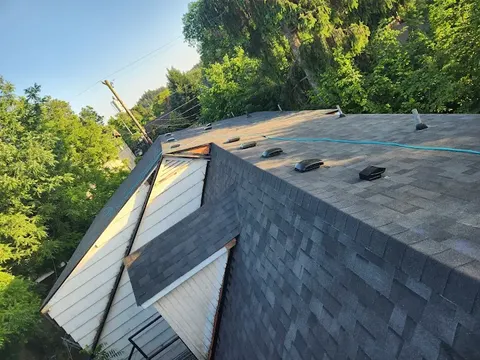
Heat-Welded Seams. No Leak Paths.
Flat roofs have one job: get water off the roof, fast. In Oregon, where annual rainfall tops 40 inches in the Willamette Valley and 70+ inches on the coast, seam integrity is everything. Rain or Shine installs TPO with fully heat-welded seams — not adhesive, not tape, not self-adhering strips that peel in a decade.
Every install includes proper slope-to-drain, reinforced flashing at all penetrations (HVAC curbs, plumbing stacks, skylights), and walk pads where maintenance traffic happens. Simple, methodical, and spec’d to last.
TPO vs. EPDM: What Oregon Buildings Actually Need
Two of the most common flat-roof systems — here’s how they stack up for Pacific Northwest commercial buildings.
TPO (Recommended)
- White reflective surface reduces cooling load
- Heat-welded seams create a monolithic membrane
- Excellent tear and puncture resistance
- 20–30 year lifespan with proper install
- Available in 45-, 60-, and 80-mil thicknesses
- Cleaner appearance for visible flat roofs
EPDM (Legacy Option)
- Black rubber membrane — absorbs heat
- Adhesive or tape seams can fail over time
- Proven decades-long track record
- 15–25 year typical lifespan
- Lower upfront cost on simple applications
- Harder to repair cleanly once it ages
TPO Installation Process
Core Test & Scope
Core sample of existing assembly, moisture scan of insulation, and a line-item bid based on what’s actually on the roof.
Tear-Off & Deck Prep
Remove old roof to the deck, replace damaged sheathing or ISO, and verify slope to drain.
Insulation & Membrane
Mechanically fastened or adhered insulation, then TPO membrane rolled and heat-welded at every seam.
Flashing & Inspection
Reinforced flashing at curbs, penetrations, and perimeter. Full seam probe and water test before handoff.
TPO Roofing FAQs
How long does a TPO roof last in Oregon?
What’s the difference between TPO and EPDM?
Can TPO be installed over an existing roof?
Last Updated: September 2026
Call for Your TPO Flat Roof Estimate
Call today and a professional roofer will get back to you right away. Free on-site inspection, core test if needed, and a detailed written proposal that covers membrane grade, insulation, and every flashing detail.
(541) 606-3306